
Transitioning from raw agricultural waste to premium granular bio-fertilizer requires a robust [organic fertilizer granulation production line](cite: 1). In modern sustainable agriculture, transforming composted manure and organic byproducts into uniform pellets solves traditional application challenges such as dust drift and uneven nutrient distribution. Establishing an efficient [organic fertilizer granulation production line](cite: 1) involves strict engineering steps, ensuring that high-capacity manufacturing plants meet international export standards and agronomic demands.
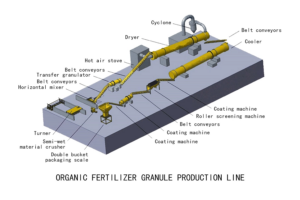
1:Composting and Raw Material Preparation
Before material enters the main pelletizing stage, proper pretreatment and homogeneous mixing determine the final quality of the fertilizer.
Aerobic Fermentation: Raw animal manure and organic residues must undergo thorough high-temperature decomposition. Utilizing specialized composting equipment helps eliminate pathogens, reduce moisture, and stabilize carbon-to-nitrogen ratios.
Crushing and Blending: Once fermented, the raw materials are pulverized into fine powders. Feeding these components into a heavy-duty twin-shaft mixer ensures that trace elements and organic matter are uniformly distributed before entering the [organic fertilizer granulation production line](cite: 1).
2:Core Pelletizing Technology
The granulation stage is the heart of the manufacturing workflow, directly shaping the physical strength and spherical yield of the product.
Advanced Granulation Mechanics: Blended organic powder is continuously fed into specialized granulator machines. Through controlled moisture addition and mechanical tumbling, the powder agglomerates into dense pellets, achieving high forming rates without chemical binders.
Size Control: Optimizing drum or pan angles inside the granulation circuit prevents oversized lumps and maintains a consistent diameter across every batch.
3:Drying, Cooling, and Screening
Freshly formed pellets contain elevated moisture levels and must be thermally stabilized before final storage or transport.
Moisture Reduction: Granules pass through an efficient rotary dryer to lower moisture content safely, protecting beneficial microbial flora from overheating.
Grading and Packaging: A vibrating screen separates qualified commercial pellets from dust and oversized particles, which are automatically recycled back into the system. Finally, automated packaging scales secure the finished product.
Conclusion
Investing in a reliable [organic fertilizer granulation production line](cite: 1) enables agricultural enterprises to convert low-value waste into high-margin commercial fertilizer efficiently. Partner with [Xincheng](cite: 1), a leading fertilizer machinery manufacturer, to customize turnkey equipment solutions designed for long-term operational durability, low energy consumption, and maximum plant productivity.